Discover Unique Handloom & Handicrafts of INDIA all along Empowering the Artisans !

Meet the Maker Series: A Day in the Life of a Dokra Artist in Bengal
For generations, Dokra artisans have transformed modest materials into objects of extraordinary character through the traditional lost-wax casting technique, known in India as cire perdue. The process is painstaking: a form is shaped in wax, layered with clay, heated so that the wax escapes, and finally replaced by molten metal. What remains is not merely an object, but a record of transformation. Yet Traditions do not survive simply because they are Old. They Survive when people continue to value them.
MEET THE MAKER
Sanjay Guhathakurta - Founder,Project rangamaati
9/17/20268 min read
Meet the Maker Series
Where Fire Meets Earth: A Conversation on the Living Legacy of Dokra
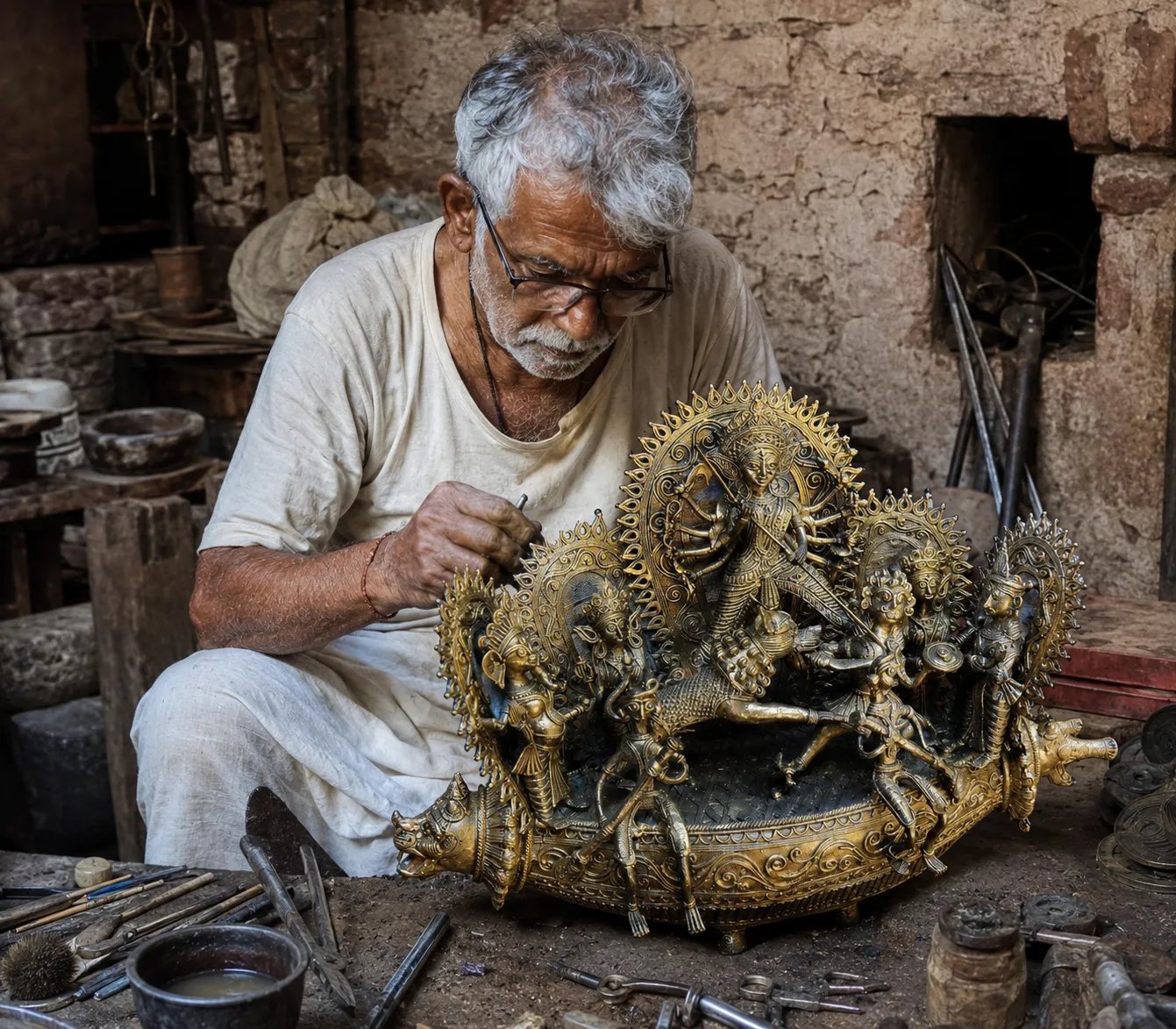
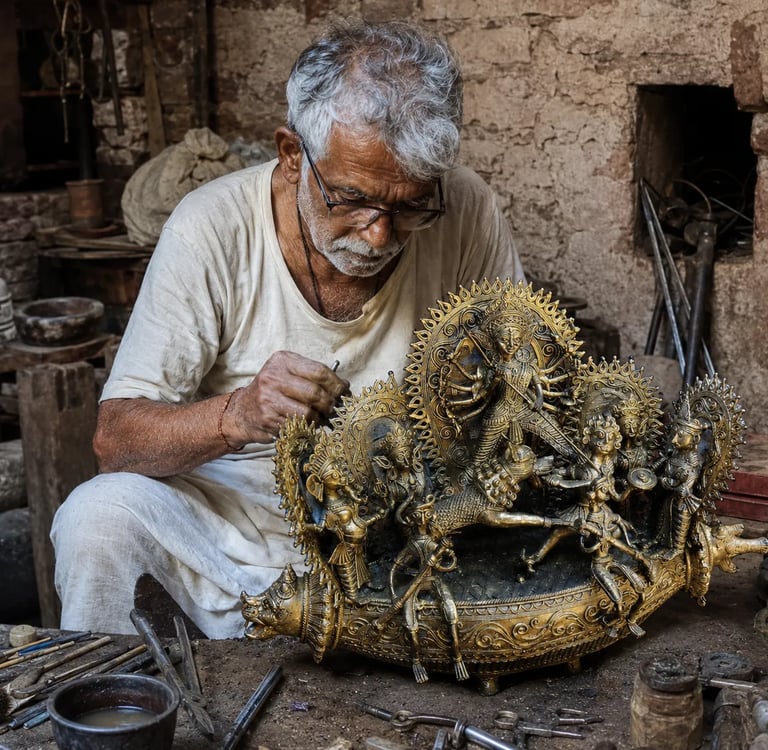
An intimate conversation between Kamal Karmakar, Dokra artisan from Dariyapur, Bardhaman, West Bengal, and Sanjay, Founder of Project Rangamaati.
There are crafts that are made by machines, and then there are crafts that seem to remember the hands that shaped them.
In Dariyapur, a village in Bardhaman, West Bengal, Dokra continues to emerge from an ancient dialogue between earth, wax and fire. Each piece carries the irregularity of the human hand—the slight asymmetry, the tactile surface, the marks of making. Nothing is hurried. Nothing is entirely identical.
In this Edition of " Meet the Maker ", Project Rangamaati brings together Kamal Karmakar, a Dokra artisan from Dariyapur, Bardhaman, and Sanjay, Founder of Project Rangamaati, for an intimate conversation about the history of Dokra, the realities behind its making, the challenges confronting its artisans, and an important question for the future:
Can an Ancient Art form find a meaningful place in contemporary everyday life?
Sanjay, Project Rangamaati:
Kamal da, when we speak about Dokra today, we often speak about it as an ancient Indian craft. But for an artisan, Dokra is much more than history. What does Dokra mean to you personally?
Kamal Karmakar, Dokra Artisan, Dariyapur:
For me, Dokra is not simply an art that I learnt. It is part of the life I grew up seeing around me.In Dariyapur, we have families who have been associated with Dokra for generations. As children, we watched the elders prepare the wax, shape the figures, make the molds and work with the furnace. Slowly, without even realizing it, we began learning.
There is a certain feeling when you see something that you have shaped with your own hands finally come out of the mold.The metal is hot. The surface is dark and unfinished. You clean it, cut away the unnecessary parts, polish it and gradually the form appears.
That moment is very satisfying.
Dokra has given our families a livelihood, but it has also given us an identity.
A Craft Shaped by Fire
Sanjay:
For someone encountering Dokra for the first time,Kamal Da how would you explain its history?
Kamal:
Dokra is one of India's oldest metal-casting traditions.The technique is very old, and similar forms of lost-wax casting have existed in different parts of India for centuries. What makes Dokra special is the way the artisan creates the entire form by hand.Traditionally, the objects were often inspired by everyday life, animals, birds, human figures, folk stories and cultural symbols.
In our region, you can see that connection very clearly. Dokra is closely connected to rural life. The designs were not created only to look beautiful. They came from what people saw around them—their surroundings, beliefs, stories and imagination.
That is why every figure has a character.
Sanjay:
There is something very compelling about the fact that no two handmade Dokra pieces are exactly alike. Is that intentional?
Kamal:
Yes and No!
We have certain traditional forms and methods that we follow. But because everything is made by hand, every piece naturally becomes slightly different. That is actually the beauty of Dokra. A machine can make the same object one hundred times.
An Artisan may make one hundred pieces, but each one will carry small differences.
Sometimes the wax thickness changes. Sometimes the hand moves differently. Sometimes the clay mold behaves differently during firing.
These small differences become the identity of the piece.
Inside the Making of a Dokra Object
Sanjay:
Kamal Da, could you take us through the process? What actually happens between a lump of material and the finished Dokra piece?
Kamal:
The process is long.
First, we create the basic form using a core, traditionally made from a mixture of natural materials such as clay and other locally available ingredients.
Then comes the wax.
The wax is carefully shaped over the form. Depending on the design, we make thin wax threads and apply them by hand to create the surface patterns and details.
This is one of the most important stages.
The design that you see on the final metal object is largely determined at this stage.
After the wax model is complete, we cover it with layers of clay to create the mould.
The mold has to dry properly.
Then it is heated.
When the mould is fired, the wax melts and flows out through the channels we have created. This is why it is called the lost-wax process.
The empty space left behind by the wax becomes the space for the molten metal.
Then the metal is heated to a very high temperature and poured into the mould.
This is the stage where we have to be extremely careful.
After cooling, we break the clay mould.
The metal form is revealed.
Then comes finishing—removing unwanted portions, cleaning, filing, polishing and giving the piece its final appearance.
And after all that, the Dokra is ready.
Sanjay:
So the Mold itself is destroyed?
Kamal:
Yes.
That is another reason every casting becomes unique.
The mold is generally broken to remove the finished object.
So you cannot simply open it and use it again.
You create the form, create the mold, cast the metal and then break the mold.
It is a one-time journey.
The Human Cost Behind the Beauty
A Dokra object may sit quietly on a shelf, its textured metal surface catching the light.
What is less visible is the labour behind it.
The process demands patience, experience and physical effort. It also requires artisans to work with heat, smoke, metal and heavy tools.
And despite the heritage value attached to Dokra, the economic reality for many artisan families remains difficult.
Sanjay:
What are the biggest challenges Dokra artisans face today?
Kamal:
There are many.
The biggest challenge is perhaps that people appreciate the craft, but appreciation does not always become a purchase.
People will say, “How beautiful!”
But then they compare the price with a factory-made product.
They may not understand how much time goes into making one piece.
Raw material costs have also increased.There is heavy GST implied on the Metals we buy.
The process requires fuel, metal, clay, wax and many hours of labor. If an artisan makes a complicated piece, it may take several days or more.
But the customer may only see the finished object.
They do not see all the stages behind it.
Sanjay:
Does the younger generation want to continue with Dokra?
Kamal:
This is a very important question.
Young people naturally want better opportunities.
If they see that another profession can provide a more stable income, they may not want to spend years learning a difficult craft.
Dokra requires patience.
You cannot learn everything in a few days.
You learn by watching, practicing and making mistakes.
If the economic return is uncertain, it becomes difficult to convince the younger generation that this should be their future.
So if we want Dokra to survive, we have to make sure that being a Dokra artisan is economically respected as well.
From Decoration to Everyday Life
Sanjay:
At Project Rangamaati, we often think about how heritage crafts can enter contemporary lifestyles without losing their identity. Kamal Da, do you think Dokra needs to evolve?
Kamal:
Yes.
But evolving does not mean forgetting our tradition.
The basic craft technique should remain.
The way we make the object by hand—that should remain our strength.
But the products can change.
Earlier, people may have primarily bought Dokra figurines or decorative pieces.
Today, we can think about how Dokra can become part of everyday life.
For example, we can explore:
tableware and serving accessories,
candle and tealight holders,
planters,
bookends,
desk accessories,
paperweights,
jewellery and fashion accessories,
door and cabinet hardware,
lamps and lighting elements,
incense holders,
small trays,
coat or wall hooks,
home décor accents,
corporate and premium gifting products.
The important thing is that the object should have a purpose.
If a young person can use a Dokra object every day, they may begin to understand the craft differently.
Sanjay:
That distinction is interesting—rather than asking younger consumers to buy heritage as something distant or ceremonial, perhaps we can make heritage part of their everyday environment.
Kamal:
Exactly.
If something is beautiful but has no place in your life, you may admire it but not buy it.
But if it is beautiful and useful, it becomes easier to accept.
Suppose someone has a Dokra desk organiser.
Every morning when they sit at their desk, they see it.
They touch it.
They use it.
Perhaps one day they ask, “Who made this?”
That is how the story begins....
Sanjay:
What should designers be careful about when they innovate with Dokra?
Kamal:
They should respect the craft.
Innovation is good.
But we should not turn Dokra into something that could have been made by a machine and simply put a Dokra name on it.
The handwork must remain visible.
The character of the metal should remain.
The irregularity should remain.
At the same time, designers can help us understand what today's customers need.
Artisans understand the material and the process.
Designers understand contemporary lifestyles.
If both sides work together, something new can happen.
When Tradition Meets Contemporary Design
This is perhaps where the future of Dokra becomes most interesting.
The objective should not be to make Dokra look modern for the sake of modernity.
Instead, contemporary design can ask a more meaningful question:
How can the traditional skill of the artisan solve a contemporary need?
A beautifully cast Dokra handle can transform a cabinet.
A sculptural Dokra hook can become a functional object on a modern wall.
A traditional casting technique can create a distinctive lamp base.
A small Dokra tray can bring a centuries-old craft into a contemporary dining space.
A desk accessory can introduce handcrafted metal into a workspace.
The design language can become simpler, more restrained and more versatile—while the evidence of the artisan's hand remains unmistakable.
This is not about replacing tradition.
It is about giving tradition new contexts in which to live.
Sanjay:
What would you like a young person buying a Dokra object to understand?
Kamal:
I would like them to understand that they are not only buying an object.
They are buying someone's time.
Someone's skill.
Someone's patience.
There is a person behind that piece.
When you buy handmade, you help that skill continue.
Maybe one day a young boy or girl from an artisan family will look at their parents and say, “I want to learn this too.”
That is the real future of Dokra.
Sanjay:
And what would you like the future to look like for the artisans of Dariyapur?
Kamal:
I want our children to feel proud of this work.
Not because people tell them that Dokra is ancient.
But because they can see that it has a future.
I want artisans to earn properly.
I want our work to reach people who understand it.
And I want Dokra to enter modern homes without losing the hands that make it.
If that happens, then our craft will continue.
The Future Is Not About Preserving the Past
There is a tendency to think of traditional craft as something fragile—something that must be protected exactly as it was.
But perhaps living traditions require something different.
They need continuity and change.
Dokra does not have to remain confined to museum shelves, souvenir collections or occasional decorative purchases.
Its future may lie in the everyday.
In the home we live in.
At the desk where we work.
In the objects we use.
In the gifts we choose.
In the details of contemporary interiors.
And most importantly, in a new generation discovering that handmade does not mean old-fashioned.
It can mean considered, distinctive, responsible and deeply human.
For Project rangamaati, this is where the conversation becomes larger than Dokra.
It becomes a conversation about the future of Indian craftsmanship itself.
How do we ensure that the artisan is not merely remembered—but remains relevant?
How do we create markets that value skill rather than simply admire it?
How do we bring heritage into contemporary life without stripping away its soul?
Perhaps the answer lies somewhere between Kamal's hands and the imagination of a new generation of designers.
Between tradition and utility.
Between the village workshop and the modern home.
Between what has been inherited and what can still be imagined.
Project rangamaati
Helps YOU connect with Slow Sustainable Fashion over Mass-Production to SAVE Natural Resources, Raw Material and reduce Wastage and impulsive Consumption.
Established in 2013 in Kolkata, West Bengal, Project Rangamaati is a leading online craft store in India, Operating under a fully integrated inventory model. This approach ensures that all products are carefully handled and shipped directly from our Central Hub, reflecting our unwavering commitment to Authenticity and Quality. Project Rangamaati stands as a trusted authority in Traditional Indian Crafts, offering Customers an Authentic connection to India’s rich Artisanal Heritage.
Subscribe to our newsletter
sanjayg@rangamaati.com
+91-9804-219-546
© 2026. All rights reserved | Project rangamaati.
Support our Crowdfunding
May We Help You
Track Your Order
Terms & Conditions
Bulk Orders.
Quick Links
Organisation
projectrangamaati@gmail.com
Got a Question? Call

Love to hear from You
Our B2C Partners
Men's Collection
WE SUPPORT SILK, HANDLOOM & HANDICRAFTS PRODUCTS ALL ALONG PRACTISING FAIR TRADE AT A FAIR PRICE.

Press & Media
+91-8902-152-405